
What's a 'Food Forest'?
A food forest is a type of permaculture gardening practice that attempts to mimic the ecosystems naturally found in forests. Permaculture means it’s a natural system to manage agriculture, in this case with a structure like a native forest. We try to plant native perennial species while experimenting with our favorite annuals. Perennials are plants like coneflower (Echinacea purpurea) that, once planted, come up year after year. Annuals are plants like corn (Zea mays) that have to be planted each year.
Why is there a Food Forest at WCC?
The WCC Food Forest was designed by students to help feed the hungry, improve food resiliency in our area and mitigate climate change. Plants will acknowledge the apple orchard upon which WCC was built and also the indigenous people who lived here before the time of the orchard.
Native Pollinator Garden
In early 2026, the decision was made to transform the Food Forest into a native pollinator garden, supporting a diverse range of pollinators and advancing the WCC Bee Campus USA initiative. The site remained largely the same, with the primary change being the replacement of currant bushes with elderberry bushes. A dedicated group of students—including members of the S4S Club, STEM Scholars, and others—collaborated with Sandy McCarthy to transition the Food Forest into a more sustainable garden.
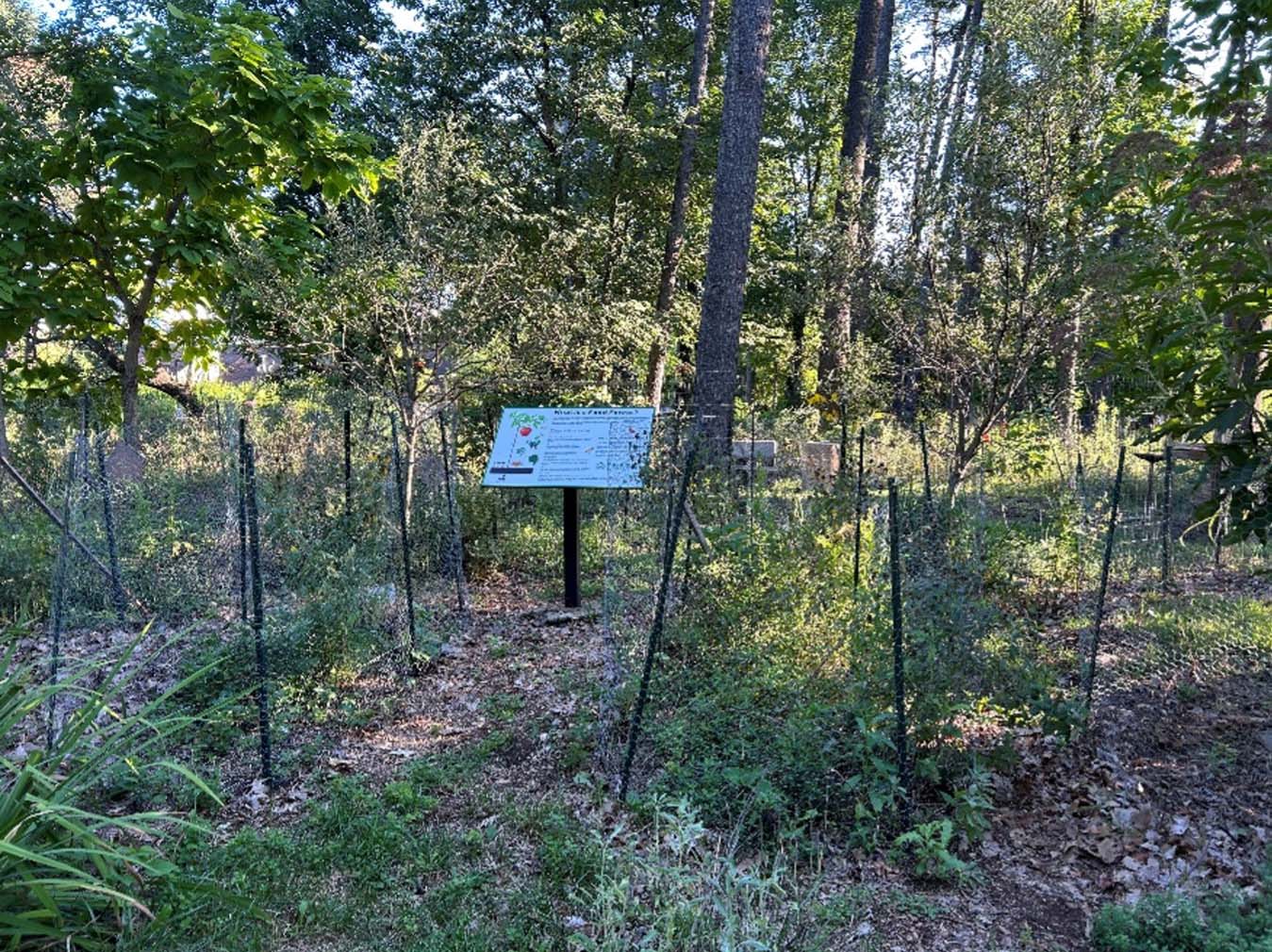
Image: copyright S. McCarthy fall 2025
What are the Layers in a Food Forest?
The canopy layer (nut trees) and sub canopy layer (fruit trees) provide shade for layers below.
The vertical layer (grape vines growing up tree trunks) provides additional food and habitat.
The shrub layer (berry bushes) attracts pollinators and can even fix nitrogen.
The herbaceous layer (dill, kale) holds soil as a cover crop and can improve soil if used as mulch.
The ground cover layer (strawberries) protects the soil from erosion and keeps weeds from growing.
The root layer (turnips) has roots or tubers that bring up nutrients from deep in the soil while the fungal layer (edible mushrooms) decomposes and recycles organic waste into usable nutrients.
Plants in the area
Bed 1 back left
Back row, 2023, all perennials, 3 strawberries
Front row, all perennials: 2 false indigo (Babtisia australis), compass plant (Silphium laciniatum), 2 marsh blazing star (Liatris spicata)
Bed 2 front left
Back row, perennials: 2 elderberries (Sambucus)
Front row possibly a black-eyed Susan (Rudbeckia hirta), anise hyssop (Agastache foeniculum), 3 native iris (Iris virginicus)
Bed 3 left of sign
Left row, perennials: compass plant, blue false indigo, Rudbeckia, 2 sage
Right row, perennials: black-eyed Susan, sage (Salvia officianalis), lavender (Lavender hidecote), (possibly a compass plant in the middle), unknown perennials that I started tall
yellow coneflower (probably Rudbeckia lacinata)
Bed 4 right of sign
Left row, perennials: 2 lavender, a couple of unknown perennials that I started from
seed
Right row, perennials: Anise hyssop (is it still there), 3 sage, Rudbeckia
Bed 5 right front
Back row: sage, 3 Joe Pye weed (Eutrochium maculatum)
Front row: 2 false indigo, anise hyssop, sage, rudbeckia, anise hyssop
Bed 6
1 false indigo
Bed 7 along the back
2 elderberries (Sambucas nigra)
Bed 8 to the right of the big sign in the back
Center circle: 4 Blue mountain mint (Pycnanthemum matium), 4 wild white yarrow (Achillea millefolium)
2nd row circle: 4 beebalm (Monarda fistulosa), 4 Ohio spider wort (Trandescantla), Spikenard (Aralia racemosa)
3rd outer circle: 8 Nodding wild onion (Allium cernuun), 4 Clammy groundcherry (Physalis heterophylla)
In the front of the garden
8 Sand Coreopsis (Coreopsis Landeolata), Lillies
Large plant pot by the bench
Yellow Coneflower, beebalm, and nasturtium seeds
Other Trees
Nut tree (Carya ovatum), catalpa (Catalpa speciosa), Eastern White pine (Pinus strobus), probably a non-native and allelopathic white mulberry (Morus)
Apple trees (Malus spps), planted 2019: left to right; unknown apple variety, Gravenstein, Gravenstein
In front of apples: garlic (Allium sativum), irises, oregano non-native (Origanum vulgare)
Added in 2025: Rhubarb (Bed behind Joe Pye Weed); 2 Paw-Paw trees (far west end); 2 blueberry bushes (Blue Crop and Northland varieties—in the center to the west of bench); Garlic (Music, Spanish Roja, Wild Garlic, and Unknown variety from FF harvest summer 2025—various locations)
Added in 2026: 3 elderberries bushes, 1 blueberry bush adjacent to the current blueberry bush.
Location and Size
The location of the garden is on the back service drive and adjacent to the Family Education Buildings. The size of the area is approximately 37’ X 92-100’.
More Washtenaw County Food Forests
Other Food Forests in Washtenaw County can be found at Buhr Park and at Leslie Park. They are both open to the public and have a wide variety of plants.
Why Else Are Food Forests Important?
Food Forests are planted to increase food supplies for humans and for native animals. Remember that it is important to try and plant as many native plants as possible. They can be easier to maintain, and they enhance native food chains and ecosystems. Many of the plants can provide habitats for wildlife like bees or birds. Remember to be pollinator-aware and leave some bare soil and refuse in the garden for insects that are overwintering. Refuse includes things like leaves, brush piles, fallen logs, and plant stems.
WCC's Food Forest History
The Food Forest at WCC was established in 2019 by the Students for Sustainability Club and Sustainability Literacy Task Force (SLTF), with help from the WCC Grounds Department. It was designed by students to help feed students, improve food resiliency in the area, and prevent climate change. Many of the plants in the Food Forest are native to Michigan. WCC was built on what was originally an apple orchard and was indigenous territory before that.
How To Learn More and Make a Difference
- Visit or volunteer in a Food Forest
- Plant native species in your yard
- Practice pollinator-aware yard care, leaving leaves, brush, plant stems and bare dirt to help native insects overwinter