Counseling Resources

833-WCC 4 YOU (833-922-4968) is a telephonic counseling service that connects students with a licensed mental health provider, 24/7. The licensed mental health providers are available to assist with numerous concerns including, panic, suicidal thoughts, rumination/worry, referral assistance, and general support. These services are available to you as a student at no additional cost.

You may have stumbled upon this page or perhaps you were sent this link from a caring instructor. Please know that WCC cares and we are here to help. If you have lost a loved one, please accept our deepest condolences. Grief and loss impact us all differently. There is not a timeline of when someone “should” stop grieving. There also is not a limit as to what someone can grieve over. Grief and loss can include the passing of a family pet, the loss of a job, divorce, friendship/relationship conflict, and many more.

You may already be familiar with the 5 stages of grief. This was developed by Elisabeth Kübler-Ross, a psychiatrist who worked with terminally ill patients. Many people often think that the 5 stages of grief are linear and meant to be completed in order. However, the process of grief is unique for everyone and many people may not experience all 5 stages. Some people may experience all 5 stages and cycle back through revisiting particular stages. Below you can see the “typical” arc of the grief cycle with all 5 stages represented; Denial, Anger, Bargaining, Depression, and finally Acceptance.
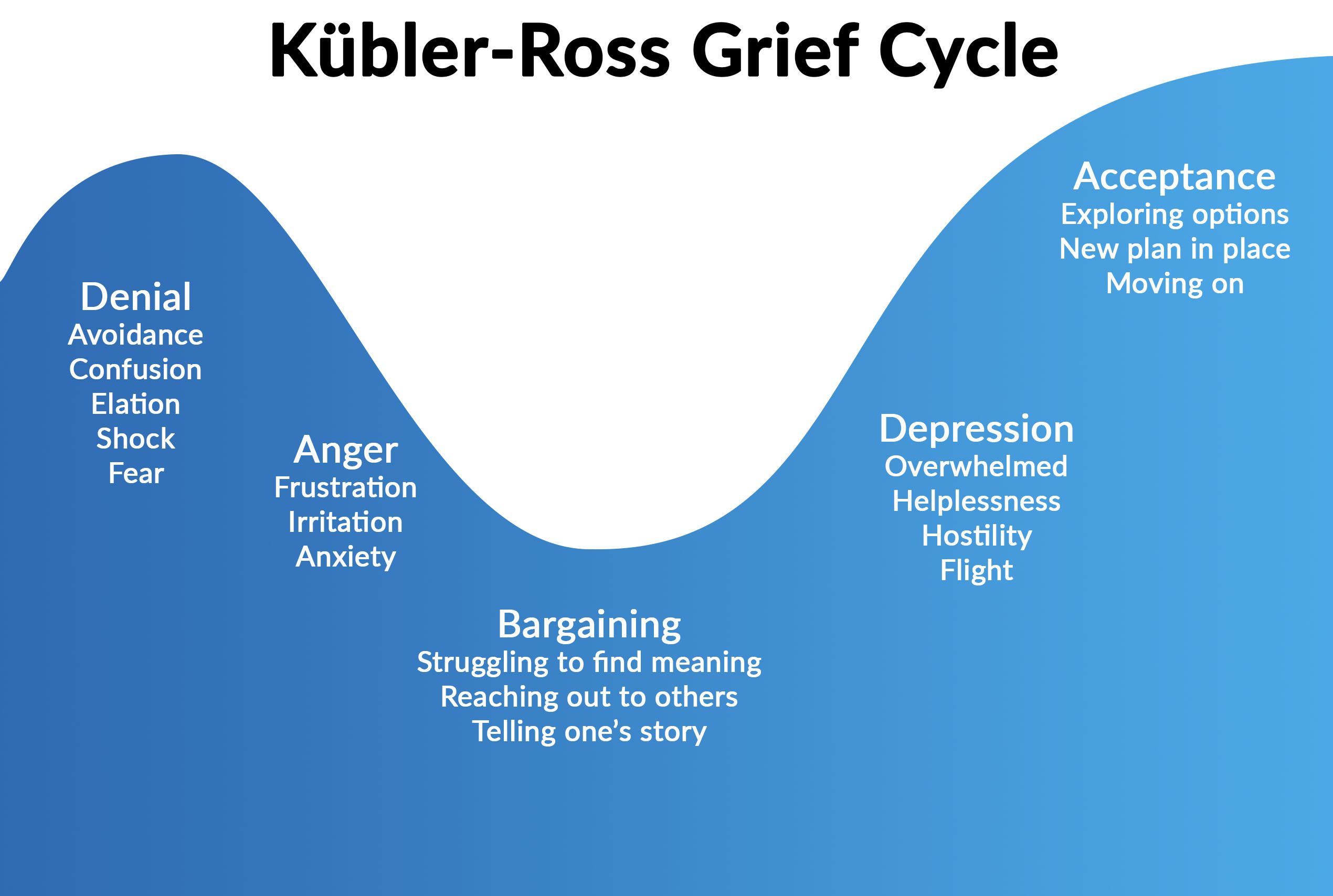
Kübler-Ross 5 stages of grief
Kubler-Ross, Doctors and the 7 day NHS | Oxford Medical Training (medicalinterviewsuk.co.uk)

We know that there is not one specific thing that can take away the pain we may feel as we go through the grief process. However, there are things we can do to help ease some of the pain of grief by seeking out internal and external support. Below are some simple suggestions that we have found helpful.

  • Prioritize self-care (exercise, nutrition, sleep)
  • Take time to understand your grief: Review the Mourner’s bill of rights
  • Stay connected with others: Talk with trusted friends, consider grief support groups or counseling
  • Acknowledge your grief in a non-judgmental way: Practice mindfulness meditation
  • Find a way to express your grief: Journal about your feelings

Resources for Grief

Personal Counseling at WCC for students enrolled in the current semester.

Coming Back, a grief and loss focused podcast.

Grieve Well is a non-profit organization that is dedicated to supporting those who may be grieving. They offer support groups and various resources to assist those who are affected by loss.

Grief Share offers support groups.

Mourner’s bill of rights

In crisis? Call or text the National Suicide Prevention Lifeline

  • Hotline: 988, press 1 for Veterans
  • Or text HOME to 741741
  • Or text STEVE to 741741 for access to a culturally trained couselor

Want to learn more or get involved?

WellTrack Boost is an app designed to help you understand your mental health and to provide you with help to improve your mental health wellness. WellTrack Boost is a suite of online tools and courses that uses aspects of Cognitive Behavioral Therapy to help you identify, understand and address issues that you are having. WellTrack uses these five steps to address your needs:

  1. Wellness Assessment – the Wellness Assessment will help you understand and track your levels of stress, anxiety and depression. Awareness of how your mental health changes over time will help   you keep things in check.
  2. Self-help for mental health wellness
  3. WellTrack Tools including guided relaxation exercises
  4. Track your progress
  5. Maintain your mental health

Mind Your Mental Health is an online newsletter written by WCC Personal Counselors covering a wide range of topics that affect WCC students.

Mental Health Screenings: Are you wondering if what you’re experiencing is a symptom of a mental health condition? Take a screening and follow the guidance provided for seeking help.

On Campus

Student Resource Center
Student Center, 2nd Floor, Rm. 206
(734) 677-5015

Off Campus

Housing Access for Washtenaw County (HAWC)
(734) 961-1999

Food Gatherers
Connect those in need to local food pantries
(734) 930-0550

Catholic Charities
815 Taylor St., Ann Arbor, MI 48105
(734) 662-4462

Personal Counseling (Personal Support)

  • WCC Personal Counseling is a free counseling service available to currently enrolled students. You can reach them by calling 734-677-5223.
  • 883-WCC-4-YOU (883-922-4968) Speak with a counselor at a call center toll free and available 24/7.
  • Welltrack is a mental health app available to WCC students at no additional cost. Welltrack Connect can provide referrals to therapists near you. Welltrack Boost provides interactive CBT-based tools to help users assess and understand their behavioral health and offer personalized recommendations for individual wellness.
  • Findtreatment.gov is a free, confidential, and anonymous resource for people looking to find mental health and/or substance use treatment in the United States and its territories.
  • SAMHSA’s National Helpline is a free, confidential, 24/7, 365-day-a-year treatment referral and information service for individuals and families facing mental and/or substance use disorders. SAMHSA can be reached by calling 1-800-662-HELP (4357) or texting your zip code to 435748 (HELP4U).
  • Psychology Today is a free resource that can help you locate a mental health provider in your area.

Communities of African and Black Descent

  • AAKOMA Project builds the consciousness of youth of color and their caregivers on the recognition and importance of mental health. AAKOMA Project empowers youth and their families to seek help and manage mental health, and influences systems and services to receive and address the needs of youth of color and their families.
  • BEAM – Black Virtual Wellness Directory helps people find a virtual Black therapist, doula, yoga teacher, mediator, and much more.
  • Therapy for Black Girls is an online space dedicated to encouraging the mental wellness of Black women and girls.

Communities of Arab Descent

  • Arab America Mental Health Association (AAMHA) is a youth-based advocacy organization that helps dismantle stigma around mental health within the Arab community and provides people with resources that guide them to help, including a directory of Arab therapists.

Communities of Asian and Pacific Islander Descent

  • Asian Mental Health Collective aspires to make mental health services easily available, approachable, and accessible to Asian communities worldwide.
  • South Asian Therapists is the largest South Asian mental health therapist and counseling community in the world, with a directory of hundreds of South Asian therapists, including Indian, Pakistani, Bangladeshi, Sri Lankan, Afghani, and Nepali heritage.
  • Yellow Chair Collective (YCC) provides culturally relevant therapy for Asian Americans. YCC takes into account who you are as a person first and what is truly important to you.

Communities of Latine and Hispanic Descent

  • Latinx Therapy is a national directory for Latinx therapists in private practice. Latinx Therapy works to destigmatize mental health in the Latinx community by providing a bilingual podcast, a national directory, and culturally grounded workshops and services.
  • Latinx Therapists Action Network is a national network and online platform centering the healing of Latinx migrant people. They offer a directory of culturally grounded, Latinx mental health practitioners who offer therapy or other mental health services on a sliding scale.

Communities of Indigenous American Descent

  • WeRNative is a comprehensive health resource for Native youth, by Native youth, providing content and stories about the topics that matter most to them. They strive to promote holistic health and growth in local communities and the nation at large.

Communities of Christian Faith

  • Christian Mental Health Initiative (CMHI) is a faith-based organization that promotes mental health awareness and education within Christian communities. CMHI provides resources, training, and support to help reduce stigma around mental illness and encourage the use of therapy, medication, and other evidence-based treatments alongside faith practices. Their mission is to equip churches and individuals to better understand, respond to, and support mental health needs.

Communities of Jewish Faith

  • The Jewish Community Mental Health Initiative (JCMHI) provides free, culturally informed mental health resources, evidence-based tools, and trauma-informed training designed to foster healing within the Jewish community. The platform offers access to over 25 weekly, clinician-led virtual support groups tailored to diverse affinity groups navigating identity-based stress and antisemitism. It serves as an essential hub for individuals, students, and professionals seeking emotional support and community connection.

Communities of Muslim Faith

  • Institute for Muslim Mental Health (IMMH) is a nonprofit organization dedicated to improving the mental health and well-being of Muslim communities through research, education, training, advocacy, and culturally responsive mental health resources. IMMH connects individuals with mental health professionals, offers educational programs and a therapist directory, and promotes mental health care that is both evidence-based and sensitive to Islamic values and traditions.

Communities of LGBTQ+ Individuals

  • LGBTQ+ Healthcare Directory is a free, searchable database that helps LGBTQ+ individuals find affirming healthcare providers across the United States and Canada. The directory includes medical, mental health, and wellness professionals who have committed to providing inclusive, culturally responsive care, allowing users to search by location, specialty, and areas of expertise.

Communities of Neurodivergent Individuals

  • Neurodivergent Practitioner Directory is a searchable database connecting individuals with neurodivergent-affirming mental health providers and coaches. The directory is designed to help autistic, ADHD, and otherwise neurodivergent individuals find professionals who understand their lived experiences without relying on pathologizing or behavioral-compliance frameworks.
  • Autistic Self Advocacy Network (ASAN) is a nonprofit organization run by and for autistic individuals that advocates for disability rights, policy change, and autistic self-determination. They provide extensive, plain-language educational resources, toolkits, and community advocacy guides designed to help autistic students navigate higher education, self-advocacy, and healthcare access.

Communities of College Students with Disabilities

  • DREAM (Disability Rights, Education, Activism, and Mentoring) is a national, student-led organization specifically designed for higher education students with all types of disabilities. It provides online peer support networks, community spaces, and educational advocacy resources to help college students navigate campus life and manage the unique stresses of disabled student life.

Communities of International and Immigrant Descent

  • Immigrants Rising provides individuals with a specialized Mental Health Connector that links them to psychological support, specialized coping toolkits, and virtual 6-week wellness support groups. Immigrants Rising is explicitly tailored to help undocumented students navigate systemic barriers, access inner resilience, and heal in safe, identity-affirming spaces.

If your community isn't represented, or you have a resource to recommend, please contact WCC Personal Counseling. Your input helps us build a more inclusive resource for everyone.

WCC Personal Counseling: 734-677-5223


Contact

Student Center, SC 206
734-677-5223
833-WCC-4-YOU (833-922-4968)
(after hours)

Hours

Mon - Thu: 8 a.m. - 6 p.m.
Fri: 8 a.m. - 5 p.m.

Take the
Next Step